Sistemas Bola-Efecto 4 – Ball-English Systems 4

16:39 |
Rodadas - Round-the-table shots:

Está claro que todos los jugadores sabemos ejecutar estas posiciones tan habituales por los sistemas tradicionales. He aquí un método que nos permitirá actuar con diferentes combinaciones de bola y efecto, lo que nos llevará a un mejor control en cuanto a la colocación de la bola 2, así como más precisión a la hora de evitar retruques.


It's clear that all players know how to solve these positions by traditional systems. Here we go with a method that allows us to act with different combinations of ball and effect, which will take us to a better control as to the placement of the ball 2, and more precisely missing the kisses.


La metodología es la siguiente: - Methodology is as follows:

1-      La posición de las bolas nos dará una calle de llegada para una cantidad de bola y efecto determinados que denominaremos “Standard” y será media bola y efecto en el ecuador y aproximadamente sobre la visual del cuarto de bola.

1-      The position of the balls will give us a line of arrival for a certain ball and english, what we call "Standard" and will be half ball and english in ecuador and about on the ¼  ball one.


2-      En el caso de que ese resultado en forma de calle fuera el deseado, sólo tendríamos ya que ejecutar el tiro. Si necesitamos “subir o bajar alguna calle” a continuación veremos cómo proceder.

2-      If that result was the desired line that we were looking for, we only would have to execute the shot. If we need "up or down a line" then we will see how we will do it.

Las calles de llegada serán las siguientes: - The arrival lines will be the next:


La posición de las bolas nos dará la calle de referencia y ésta vendrá dada por la posición de la bola 2 así como el desfase entre las posiciones de las bolas 1 y 2.

The position of the balls will give us a certain line and it will be defined by the position of the ball 2 and the gap between the positions of the balls 1 and 2.

Posición de la bola 2: - Two-ball position:


Desfase entre las bolas 1 y 2: - Gap between one and two balls:


          Haremos lo siguiente: - We will do the next:


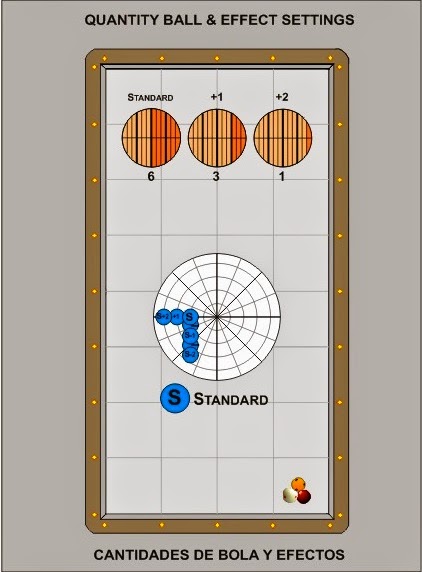
        Para subir o bajar calles lo haremos cambiando los registros estándares de efecto, de cantidad de             bola incluso de la combinación de ambos. Tomando menos bola alargamos o subimos calles, dando             más efecto ganamos calles y bajando los registros del efecto, cerramos o bajamos calles:

        To raise or lower lines we will change the standard amounts ball and english, even the combination of         both. If we take something less of ball, go up streets; giving more effect go up lines; and lowering the             spin points, lines go down:


          En la medida de lo posible, trataremos de no abusar del efecto máximo y la cantidad de bola mínima             pues corremos el riesgo de pifiar o de irnos sin bola.

          As far as possible, we will try not to abuse the maximum english and minimum amount of ball because           we have the risk of blunder or make an “air ball”.  

          Ahora algunos ejemplos… - Now we will see some examples…

          En este primer ejemplo, calculamos la posición y nos da la calle3, pero la bola roja se encuentra en el           rincón o lo que es lo mismo, la calle 2. Tendremos que bajar una calle y lo haremos bajando un                     registro de efecto:

          At this first example, we calculate the position and we find line 3, but the red ball is in the corner or                what is the same, line 2. We'll have to go down a line and we will a register down of english:


          A veces, también habrá varias soluciones: - Sometimes several solutions can happen:


    Algunos más... - A few more:


Clip:
Nguồn: http://acbillar.blogspot.com/

Dobletes – Zig-Zag Shots

16:36 |


Clip:


Nguồn: http://acbillar.blogspot.com/

Patrones-Standards

16:30 |
Las jugadas patrón son posiciones particulares que con una cierta linealidad nos facilitan una solución conocida, para diversas ubicaciones de las bolas dentro de la mesa.

Son fácilmente reconocibles a simple vista apenas se paran las bolas y una vez conocidas nos ayudan a liberar la mente de cálculos y aliviar un poco la presión permitiéndonos agotar gran parte del tiempo de tiro de una manera más relajada.

Al principio parecerá que es difícil que las bolas vayan a quedar posicionadas así fácilmente pero, una vez conocidas, os sorprenderá lo que se repiten las posiciones madre o unas cuasi similares.

The stardard plays are particular positions with a certain linearity we provide a known solution, for various locations of the balls in the table.

They are easily recognizable at first sight  just stop the balls, once we known them, and help us free the mind from calculations and relieve some pressure allowing us to spend a lot of shooting time in a more relaxed way.

At first it will seem that it is difficult that balls are positioned in this way so easily but, once known, will surprise you how many times positions or similar will repeat.

Los patrones del 4 – Standards 4

El punto de llegada siempre va a ser el rombo 4 de la banda larga y tenemos tres familias de jugadas que van a ser susceptibles de estas jugadas patrón: Rodadas, cabañas y pluses.

The arrival point will always be the diamond four of the long rail and we have three families of plays that will be susceptible to these stardards: Round the table, short boxes and pluses.

Patrón 4 rodadas – Standard 4 round the table shots

Si las bolas 1 y 2 están alineadas (a la misma distancia de la banda larga, tomando un cuarto de bola con efecto 3, siempre llegaremos al rombo cuatro.


If the balls 1 and 2 are aligned (at the same distance from the long rail), taking fourth ball effect 3 always get to diamond four.


Si la distancia entre ellas es de menos de dos rombos, esta linealidad nos vendrá dada, como siempre, por las tangentes interiores.

If the distance between them is less than two diamonds, this linearity will given us, as always, by the inner tangents.


Con ajustes tales como los que veíamos (aquí), podremos cambiar calles de llegada usando este sistema como referencia; esto requerirá de bastante entrenamiento, claro está.

With settings such as we saw (here), we can change lines of arrival using this system as a reference; this will require a lot of training, of course.

Patrón 4 cabañas – Standard 4 short boxes

Para bolas 1 y 2 ambas situadas por debajo del rombo dos. Si el tome de bola es tal que nuestra bola salga paralela a la banda corta con efecto 4, siempre llegaremos al rombo 4.

Balls 1 and 2 both located below the second diamond. If our ball leaves parallel to the short rail and english 4 we will always get to diamond four.


Una vez rebasada la visual del rombo dos ya no será válido por razones obvias:

Once overtaken the visual of the second diamond, the system will not be valid for obvious reasons:


Patrón 4 pluses – Standard 4 plus shots

Bolas 1 y 2 alineadas y por debajo del rombo dos. No cabe duda de que es la menos común de las tres, pero no está de más conocerla, si hay menos de un rombo de distancia entre ellas, la linealidad, como siempre, vendrá dada por las tangentes interiores. Tomando un cuarto de bola con efecto 3, llegaremos siempre al rombo 4 de la banda larga.

Balls 1 and 2 aligned and below the second diamond. No doubt that is the least common of the three, but it is worth to learn it, if there is less than a diamond away between them, linearity, as always, is given by the inner tangents. Taking fourth ball and english 3, we will always get to diamond four of the long rail.


Hay posiciones en las que nos será imposible tomar un cuarto de bola y llegar a la banda corta. Cuando esto ocurra quizá el punto sea más fácil de ejecutar de cabaña, por la derecha o por la izquierda.

There are positions in which it will be impossible to take fourth ball and get to the short rail. When this happens maybe the point is easier to run through short box by the right or left.

Clip: